My Creative Practice, from A to Z
I’ve been learning all sorts of fancy words, reading authors who are tricky to understand, and stretching my brain to figure things out. Forgive my naiveness, but when I was tasked to create my ‘visual lexicon’, I had little idea what I was supposed to do. I was embarrassed to ask because the dictionary definition sounded simple enough: I needed to create my visual vocabulary. Just in case you need it too:
Lexicon
figurative. (a) The vocabulary proper to some department of knowledge or sphere of activity; the vocabulary or word-stock of a region, a particular speaker, etc. (b) A list of words or names.
So basically, I was being asked to play with letters and marks, sign me up twice!
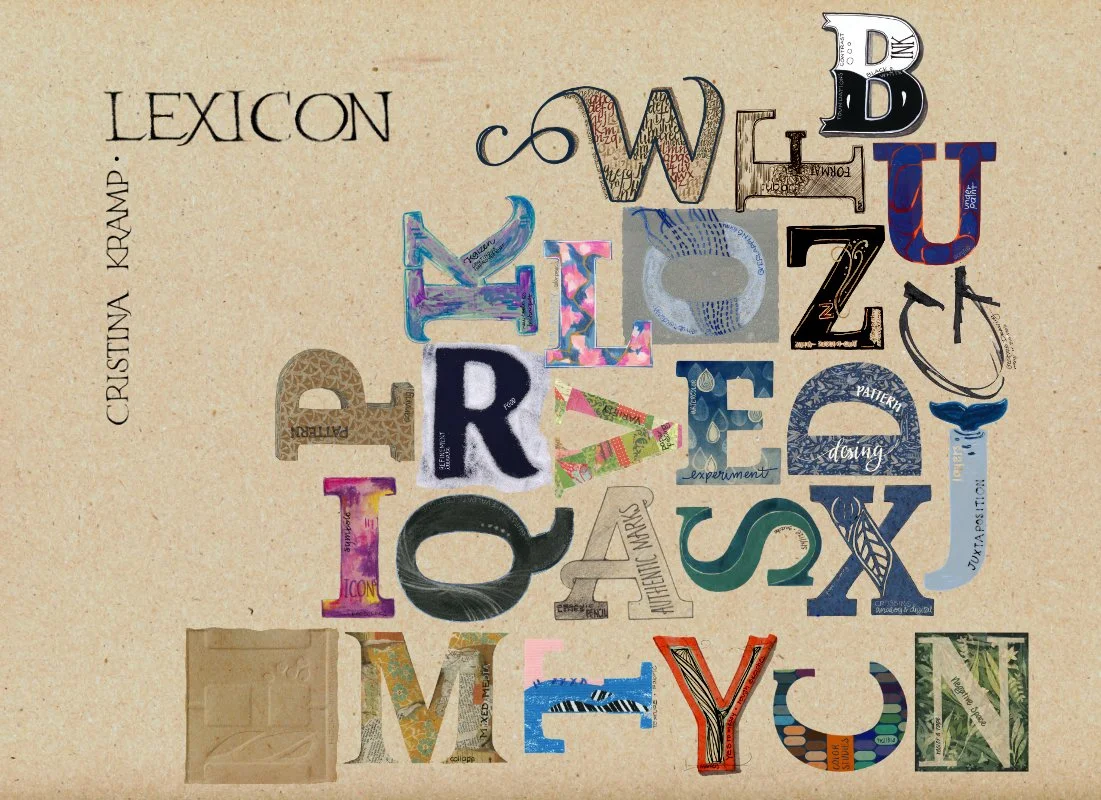
Cristina Kramp’s visual lexicon of elements
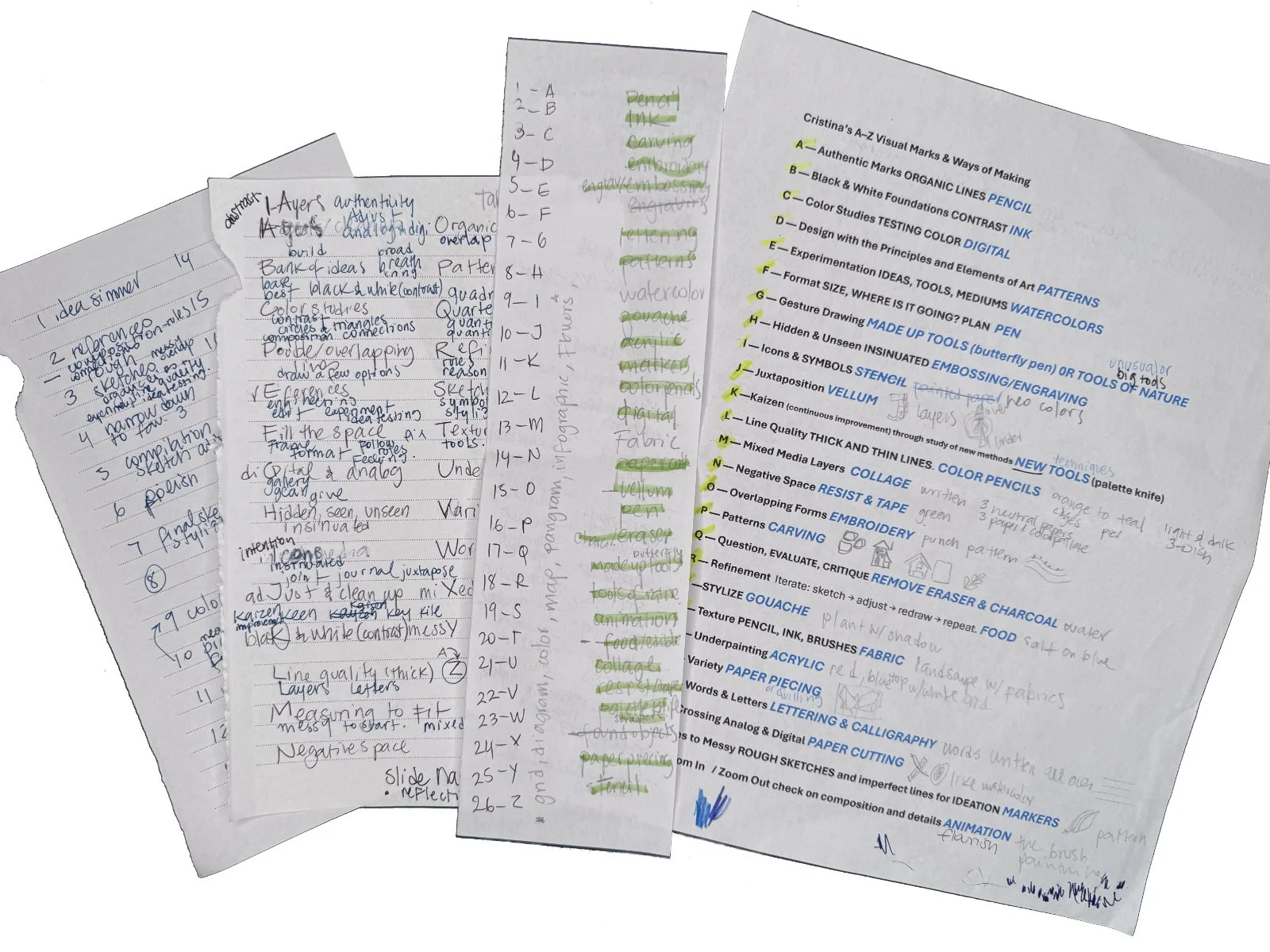
brainstorm of ideas
I took inventory of the last 5 years of creations and found patterns. I made lists, rewrote them, organized them, and added techniques and mediums I’ve been wanting to try too. While learning about Nietzsche’s Dionysian energy of instinct, emotion, and messy work, yep I was there in no time. I also had to summon the Apollonian energy of reason and order to make this happen. So, I settled for an organized randomness. Go figure!
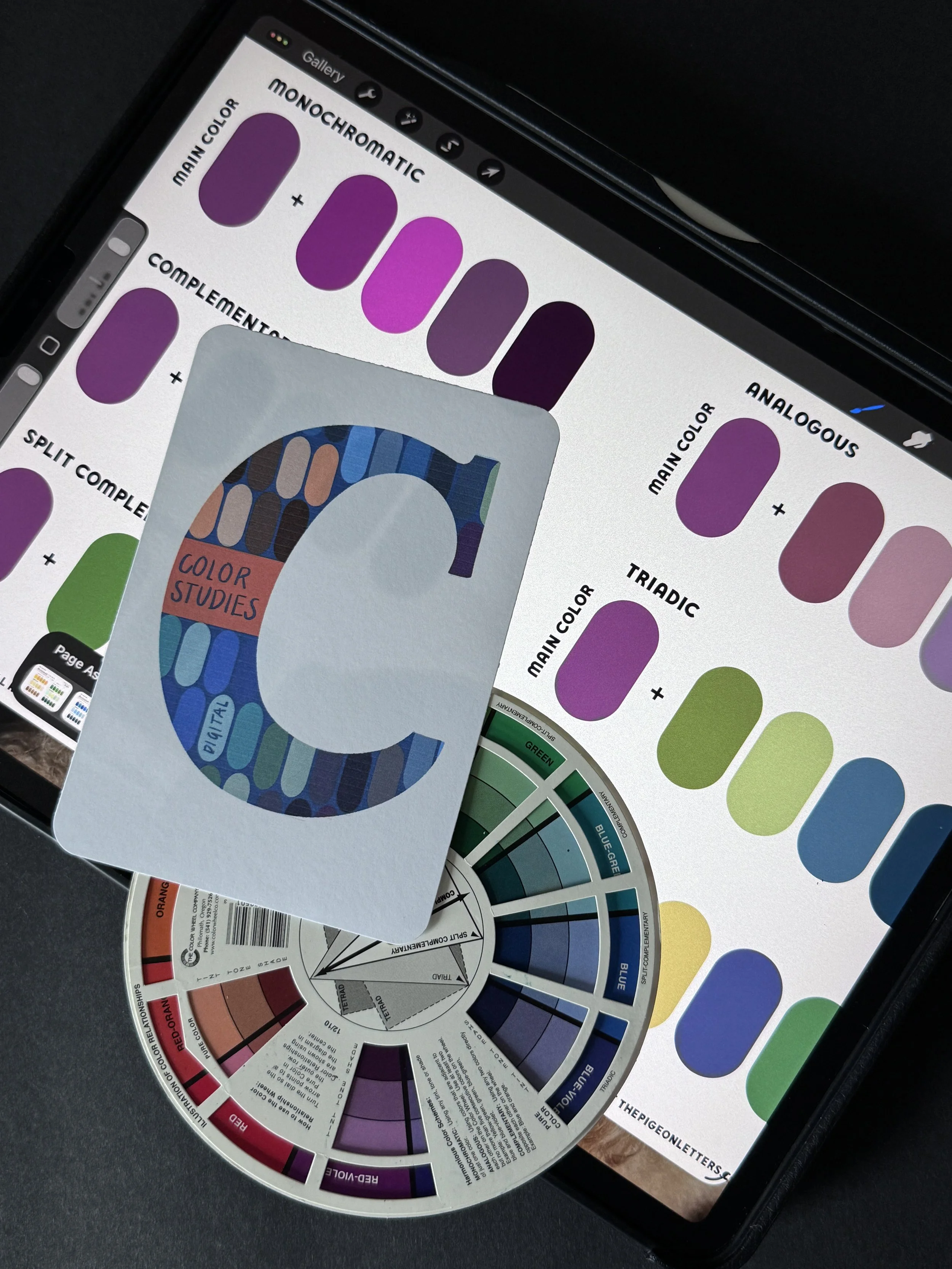
As far as the patterns I found: no surprises, water media is a got to of mine, as are stylized and expressive lines, lettering, icons, and patterns. Digital drawing has made rearranging elements so much easier, so I’ve learned to embrace technology and use it to my advantage. My lexicon paired each alphabet letter with a technique and added a medium for a variation and flexibility. For example C is for Color Studies: Testing color - digitally. Do I know how to complicate my life or was this the coolest puzzle to work on? Both.
For the layout, I was inspired by drawers of old typefaces and the grid work of Lisa Congdon art.
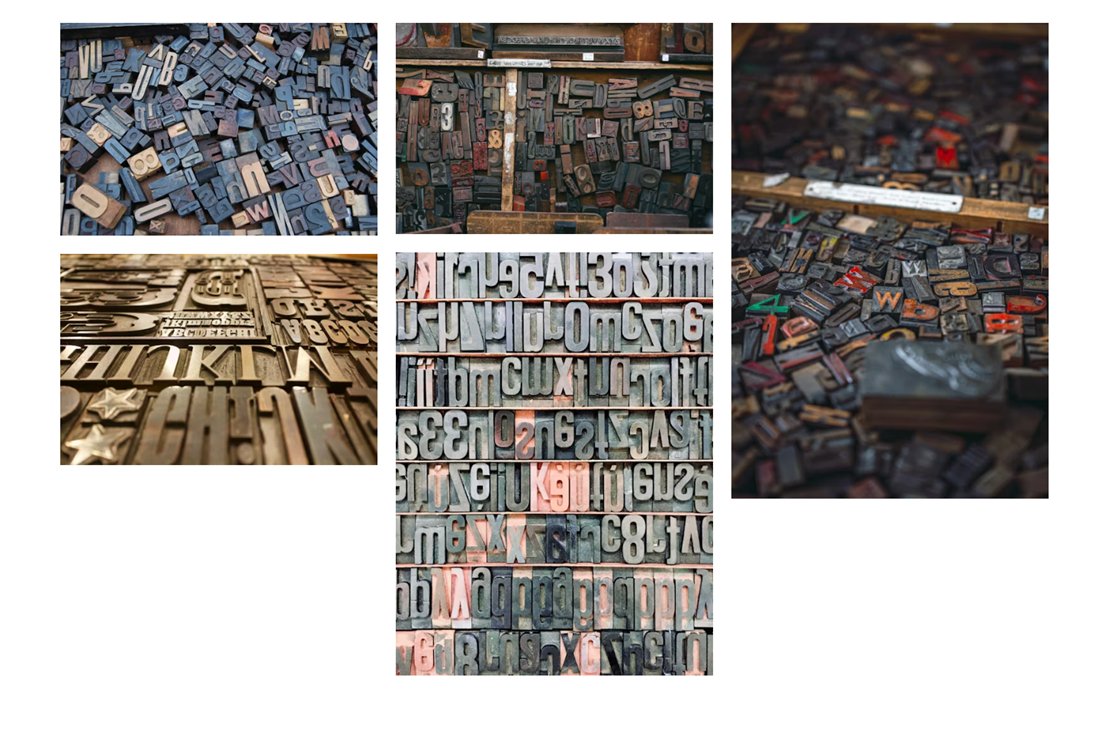
From left to right photos by: Amador Loureiro, Bruno Martins, Mattia Cioni, Marcus de Paula, Fabio Bruun - on Unsplash
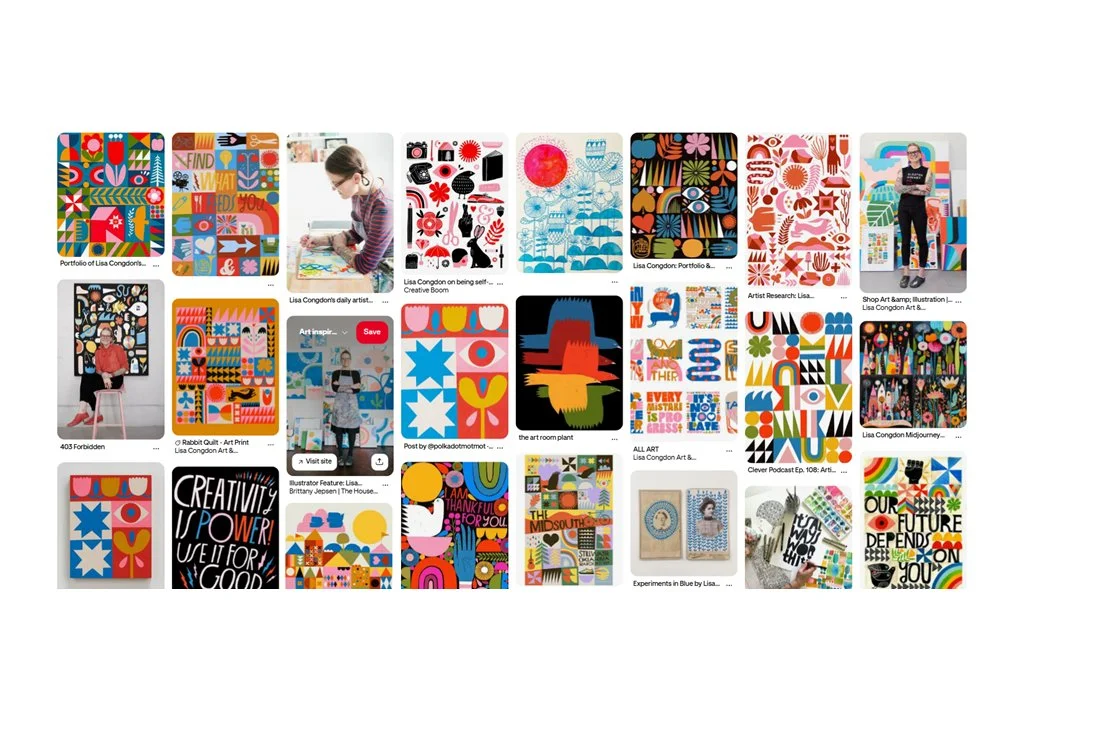
Lisa Congdon’s sample work on Pinterest
This project was all about experimentation, even in the design process. I used 3D printed block letters to find a layout I was happy with. It became a very hands-on, trial and error process, and eventually I landed on something both pleasing and literally significant. The chunky letters housed the marks they each represented. I ended up modifying 21 of the letters to give them different personalities.
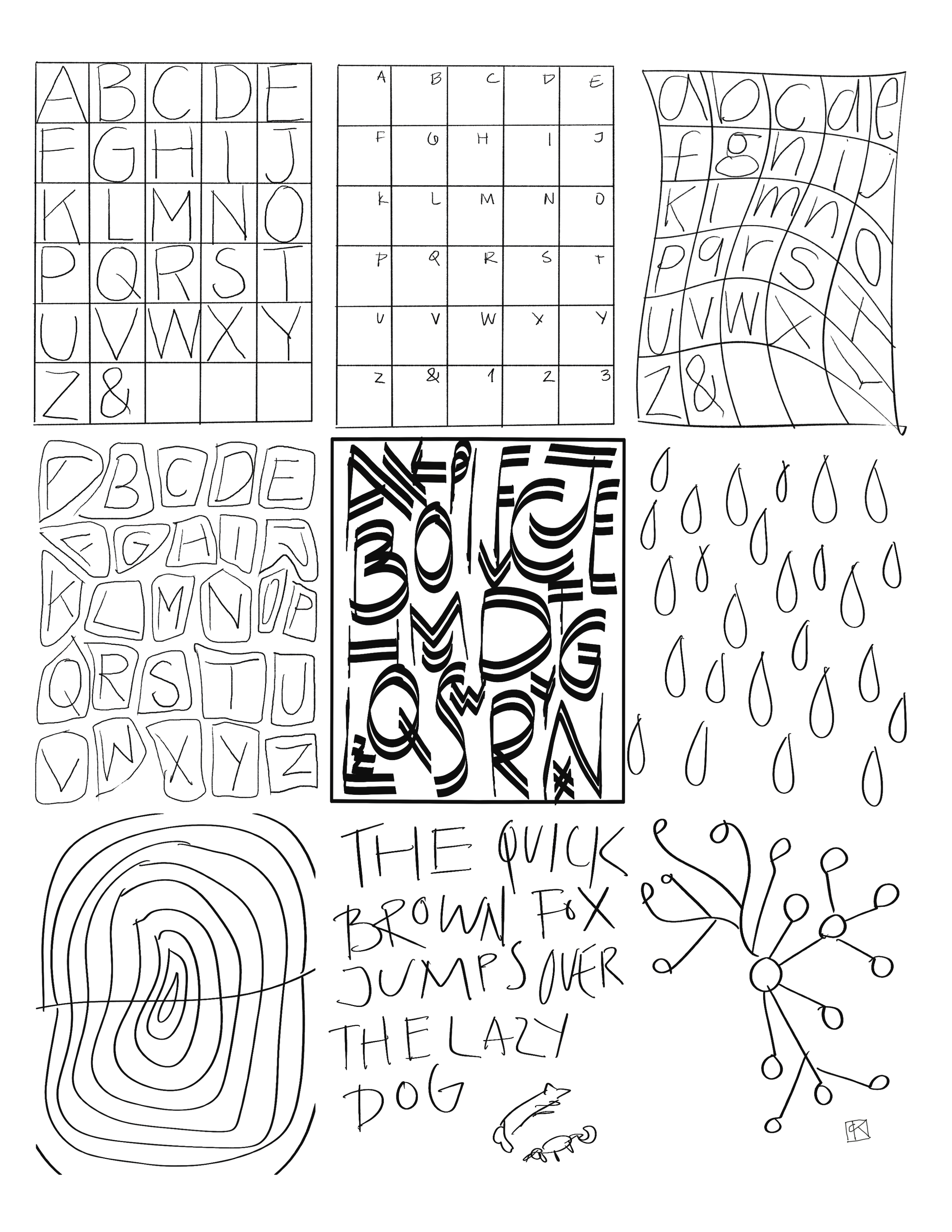
Layout exploration
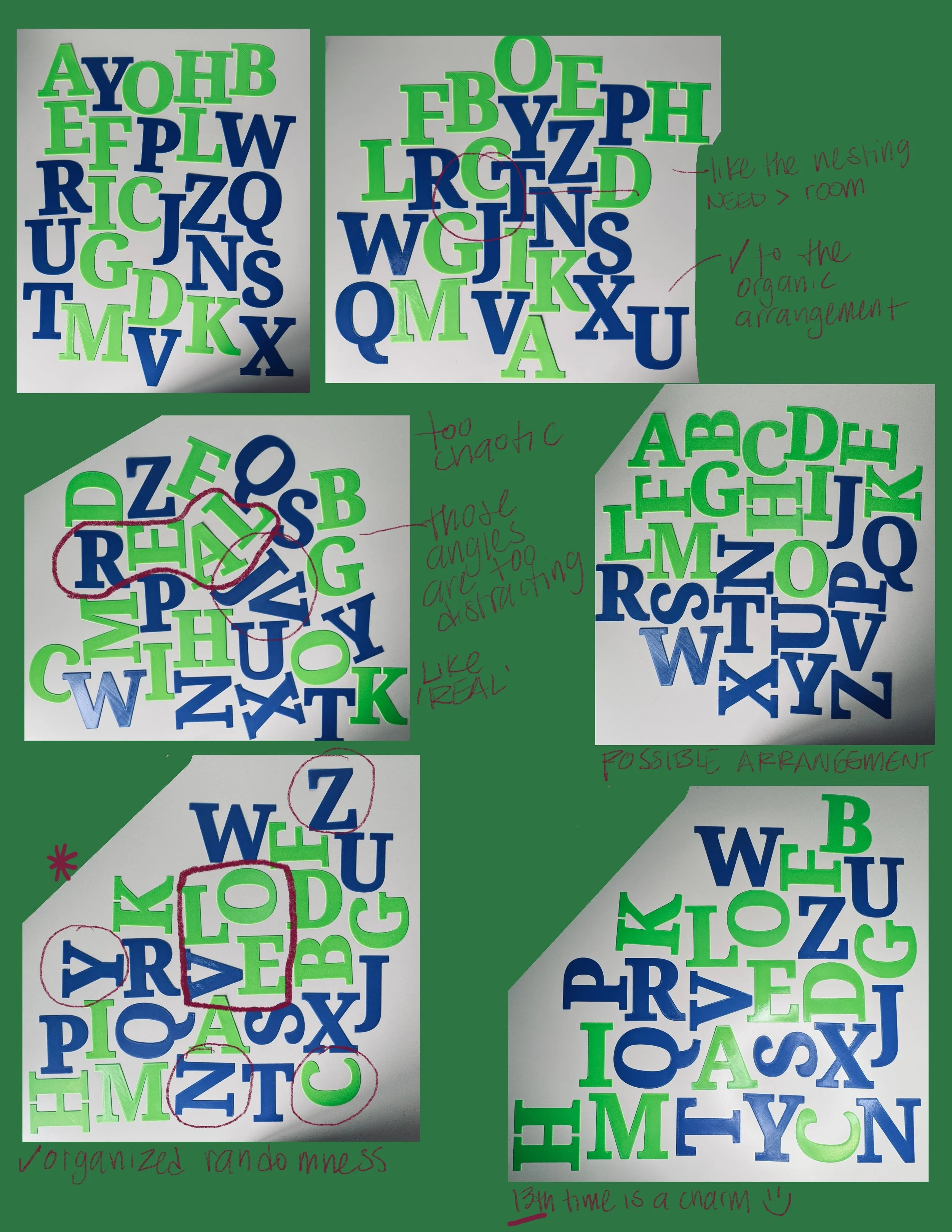
Physical layout experiments
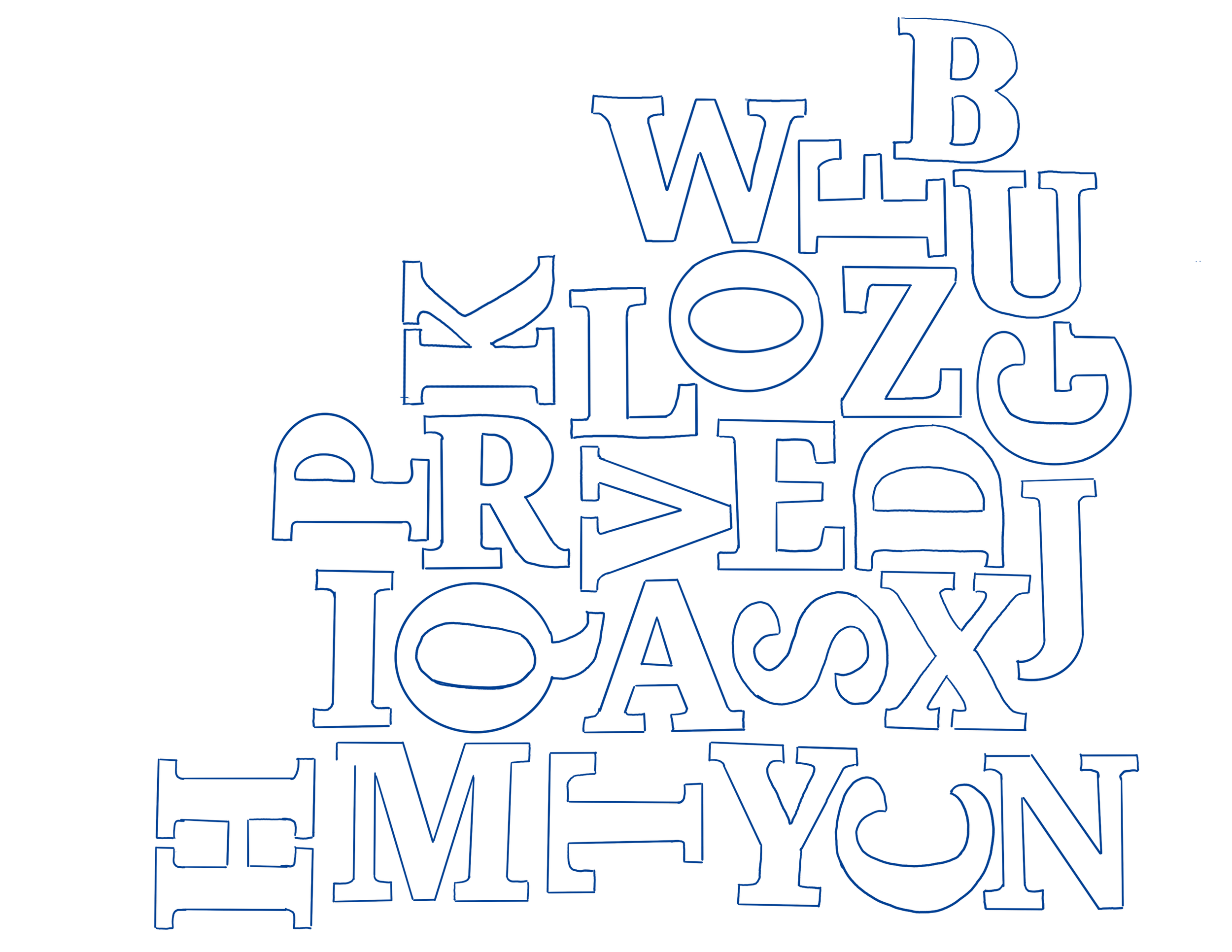
Chosen layout outline
As intimidating as it was to start, simply opening my sketchbook and picking a letter got the wheels rolling. I already had the list, so there was no guess work, mostly execution, and I got lost in the making. It was a blast, even the ones that didn’t work out, and there were a few. For my art practice this adds a deeper level of intention, I chose the marks that aligned the best with what I naturally create.
Lexicon letters on my sketchbook
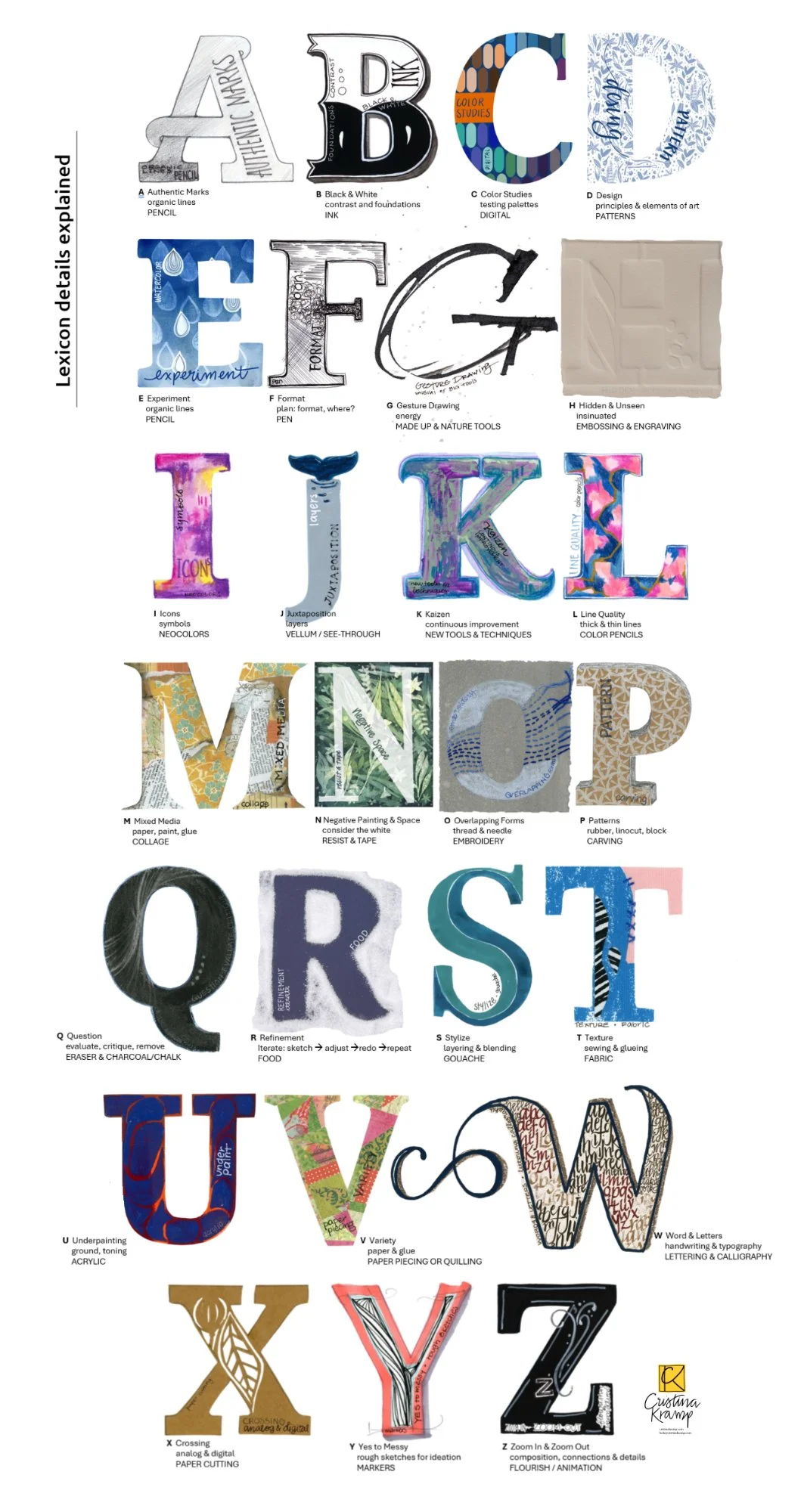
Cristina Kramp’s full lexicon with explanations
What has been most helpful is having them as cards to pull and combine, adding a challenge to whatever I am illustrating.
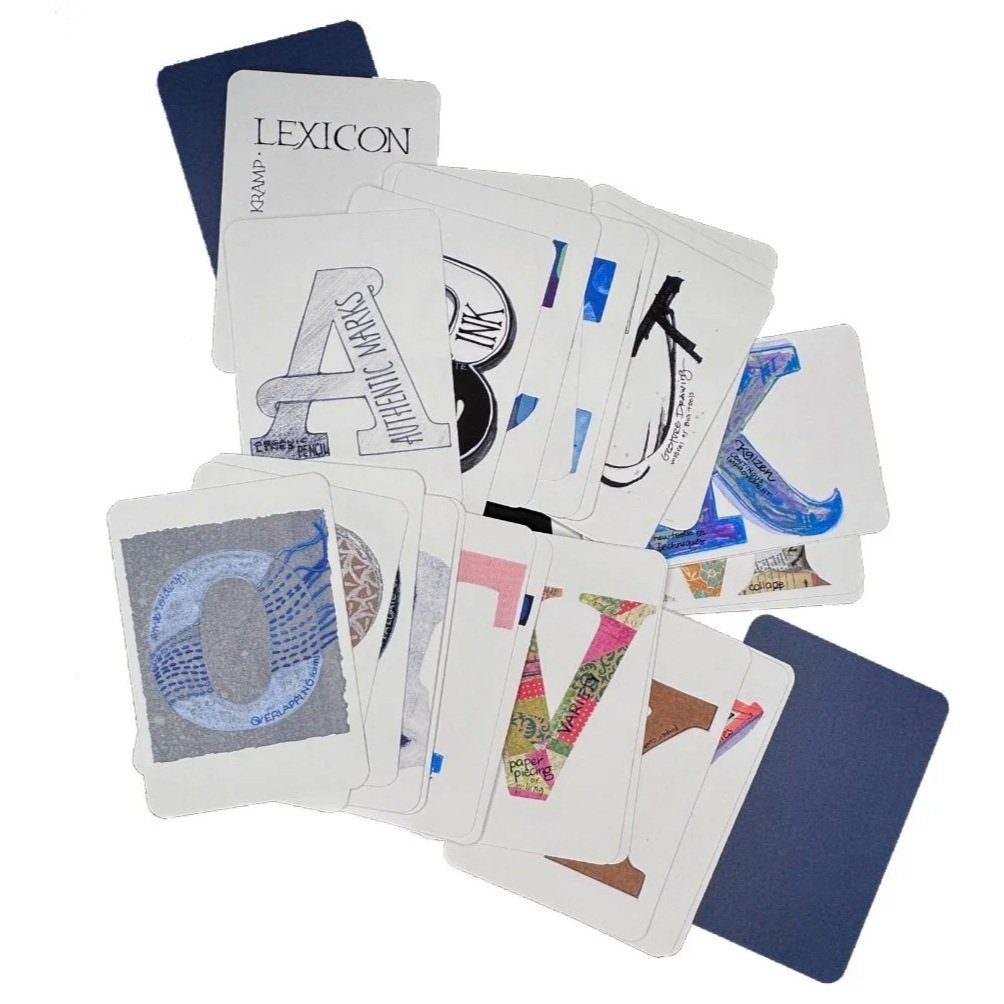
CK Lexicon’s cards
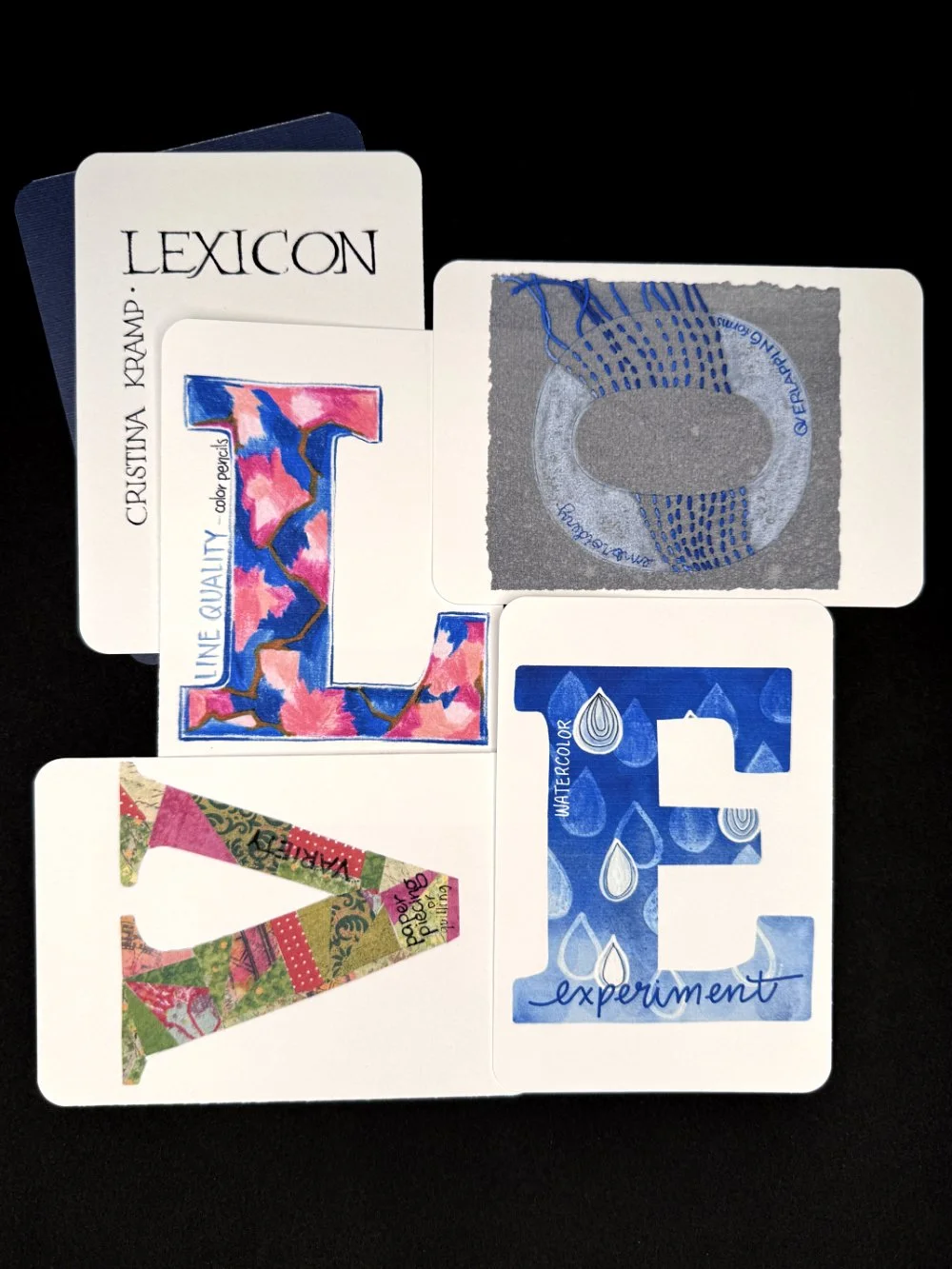
Borrowing the words of Ursula Le Guin: this lexicon is the “sack […] that holds words [and images]. They bear meanings. […] a medicine bundle, holding things in a particular, powerful relation to one another and to us.”
Her words describe what this project feels like to me “a medicine bundle”, a living collection of possibilities. A gathering of marks, symbols, textures, tendencies, hopes, colors, and new ways of seeing. Some I am familiar with and others patiently waiting for me to try. Combining them is what creates meaning and are enriching every image I have created since.
I feel I carry this big bag full of opportunites waiting to be explored, combined and tested. A personalized toolbox. An evolving visual language, or lexicon to be fancy, to aid me when I get stuck or curious. This bundle means many new ways of noticing, interpreting, and connecting.
Don’t you think we all carry a “medicine bundle” full of our experiences, memories and what we value most? So, what would you put in your personalized toolbox?